Monday, December 3, 2012

narrative: The narrative excels because it highlights the main parts of the films narrative without giving away the ending or all of the rising action or climax.
The plot is, theres a normal family, the zombie Apocalypse starts. they escape and learn to fight them, the government wants the main character to fight for them, he says he wont leave his family and will come back for them, then the rest of the movie he wants to get back to his family
 Normal family:
 apocalypse starts:
learn how to fight:
Government asks him to fight:
fighting to get back to family:


mis en scene: The mis encene was very compelling because it highlighted the amount of chaos and terror a zombie would apocalypse would be. It showed how many people would be running around crazy like, them military coming in to try to stop it. It also just shows the ultimate terror that a lot of zombies would bring to the world. It demonstrates how much chaos would be involved in this scenario. it overall shows the genre of film, a type of action survival movie.     

the cinematography of the film does a fine job at showing the nature of the film . This shit for example shows a lot of zombies all trying to climb their way up a ladder. The shot starts of at the top of the ladder with one zombie and slowly moves its way down revealing more and more zombies as they all funnel their way up the ladder. The shot makes the trailer successful because it is awe-inspiring it shows the overall action that the film will hold inside of it. 
The edit does a good job at highlighting the action of the film. The edit shows the overall theme of action by connecting multiple shots quickly that have some type of theme in common. Like running towards a helicopter jumping then showing people skydiving from the helicopter. or by showing multiple shots of people shooting at each other, or rather zombies i guess.                


The score does a good job at explaining the action and the thrill of the movie. It has lulls and intense points. The lulls are around when they are running or talking then the intense parts come in when you see someone jumping off a building or they see a horde of zombies. The intense parts of the sounds convey the action and intense parts of the film.                            


Monday, November 26, 2012

Dracula


The principal subject of this documentary is Dracula, the story, legened and the man who inspired him Vlad the Impalar. It talks about the stories behind Vlad and how he inspired the vampire story. It also talks about hte history of the town Vlad was in, Vlads own history, how vampires myths could have started.

The film has many interviews with all people that could have presence in the analysis of Dracula. They interview peole form the town in which Dracula was born and lived. you find that Vlad the Impalara was a national hero there. They interview scholoars who talk baout Vlads life. They interviewed a vampire hunter as well.

When talking about Vlad the Impaler life, they often show clips from other films centered around Vlads life when talking about specific times in his life. Also they show paintings and drawings of Vlad and his conquest. When talking about Dracula the novel they show several shots from the film adaptations.With adtions of these shots they want us to expirence not only the film and words but also get a sence of what they are talking baout letting our sight help in the overall picture of who Vlad and Dracula were.

The voice over that the film uses is used to add additional knowledge that who they were interviewing did not fully convey at the time. Also the voice over is used as a transition at times. It is used so that multiple points could be brought together without seeming awkward.

The documentary does not seem to have spontaneouse dialouge. The time the people are interviewed they are usually shown in an establishing shot and then introduced.

The people interviewd in the film are citizens of the town where Vlad lived inorder to get an insight on public opinion of Vlad. Others are scholars who talk about the conquests of Vlad to help understand who he was. The scholars also talk about the life back in the 1500's to give insight into how cruel Vlad may have been. They bring in doctors to understand how the vampire myths may have been creating by talking about vampire like symptoms of the film.

They use many paintings of Vlad, to show how t=he was seen in the ancient times.

Some of hte scenes are composed. when talking in the city Vlad was born in there is the presence of a statue of Vlad behind who is being interviewed.

The interviews the Documentary film maker uses are heavily edited. Many of the interviewers are brought up several times through out the length of the film. The way the film is edited is it starts with the idea of dracula, has people brought up about htat then slowly moves into Vlad, how Vlad came to power and his life, how vlad represented dracula and how vampires came about. Through out the film many people are brought up again as they have many points for the different topics.

When talking about torture, the undead and being buried alive the is a slight dramatic score going on in the background. Them music creates a more dangerous atmosphere around the information being presented.

The film maker do-sent change angels much. They usually start with an establishing shot of the interviewee then move to a close up of the the interviewee. From there the camera stays in a fixed position. At time the camera is angled different to show something behind the interviewee or to reveal something else.

Overall the documentary was very effective. It gave out valuble inforamtion of the start of Dracula the actual dracula and the implications the actual dracula has today. It also gave out valuble inforamtion on how vampire myths and legends may have been started and how they have evolved through out the ages

Friday, October 5, 2012

Pudovkins: concept on constructive editing was that each shot had to make a new point. It was not the shot itself that he cared for it was the juxtaposition of shots that he believed would create new meanings. belived only CU's and textures were acceptable, long shots were to close to reality and that a jumble of juxtaposition was a better concept of reality.The kuslhov effect is when you get the emotion not from the actors acting but instead by the juxtapositions. The viewer gets the emotional feeling once the correct objects have been put together in the film Eisenstein: montage was were he believed that film will be created by juxtaposing two contrasting opposites. He believed that all phenomena were subject to change. Smooth transition was not preferred instead harsh contract was better. He believed that by showing a thesis and antithesis that a new idea would be synthesized. in the odeasa steps the eisenstien style creates ambiguity of the film. It shows good then bad, bad the worse worse then good. There is no dialog. Allows viewers to synthesize own ideas about film by showing good with bad. Andrea bazins idea was realism. He belived film was the most real media. Belived montage was one of the many tools film makers had at there disposal. Belived a film became real because of its ambiguity. Allowed the viewers to make there own interpretations of the film. Belived classical cutting was to impsoing took away the viewrs ability to make own ideas. Used long shots and panning trucking and tilting rather than cutting.

The " Man with a Camera" is based off the kuslhov effect. It has sharp contrasts and not smooth transitions is aopen for interpretation. In bicycle theif it has more of a realist shooting with some of pudovkins concept of constructive editing. From the shots in bicycle thief  it holds out long shots of bicycles back and forth, we get not much of a responce from the actor but from the holding of the scene we understand what the actor is going to do, steal the bike.


Thursday, September 27, 2012


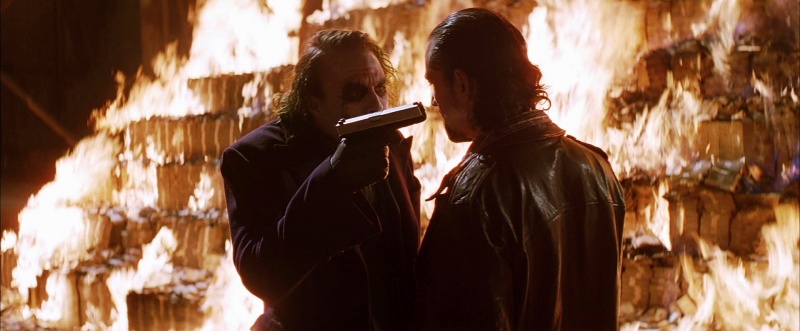
The character i choose was the Joker from the film the Dark Knight rises. The joker always dress in a purple pinstripe suite, with a green vest and blue shirt. His high class wardrobe provides a contrast to his facial makeup which is composed of white facepaint black eye shadow, green hair and an eerie ear to ear smile. The jokers wardrope and body language match his person: crazy. His wardrobe contradicts his face which gives the impression of chaos. His body language is he uses wild hand gestures and flips his tongue when he speaks. His persona is just chaos, he hardly ever does anything for personal gain he just does it because it will cause chaos. In this scene the Jokers purpose is just to demonstrate who he is. He tells people his idea of chaos and how gotham needs a new high class villain. He proceeds to demonstrate his philosophy on chaos by burning a giant stack of money they had just stolen. His only real character flaw is what his character is. His insanity is what puts him into danger and is what makes Batman try to stop him. The way the joker gets past his insanity is he really dosnt, but however his insanity almost saves him. since the joker wanted no monetary value from anything he did he just wanted to do it for the chaos it made it hard to stop him as there was nothing to hold against him.

Tuesday, September 18, 2012

The surreal photos of Martin Marcisovsky. This photo is one of the many surreal photos of the dubblin photographer. his photos show a world that seems non existent. They involve a single protagonist usualy with there backs turned towards the camera. The photos have there own scene of mystery to them as iit gives no back story of who is there or why the person is there, however the photos allow the viewer to develop there own ideas on what the photo is.  Its vagueness allows them to create there own idea for why this lonely protagonist is walking in some strange desert. It gives the viewer the idea that they are lost and exploring some new spot in their own mind,

Friday, September 14, 2012

when you find me

Character: In when you find me, at the beggining they set up the character as a girl with plenty of imagination. You can already see from how she is dressed that she is a character with a wild personality. Personality that dosnt take the world as it actually is but instead makes up her own one.


the setting.  This setting is supposed to be one in the afterlife. The setting does a good job of portraying how the afterlife should be. The colors in the shot, white, make it seem very peacful and sercene. Also the lone tree with endless hill ranges give it the idea of tranquility. That its a quite and peacful palce


Back story. This shot  is the first shot the movie shows of the mother and with this one scene you can already tell a lot about her. You can see that she has been hospitalized for quite some time now most likely with cancer as she has a cap on which indicates she is bald. The shot also shows that she has recently died as her arms and face are limp while she is being hugged.


Goal: form this shot you can tell that the goal is to see the mother again. The mother is shown using a different medium to show that she isn't part of this plane of life anymore. The goal of the youngst daughter is to see her mother again when she was alive and not affected by her disease


Time, In this shot by the light of the sky and the fact that the girl has a lantern you can determine that the time is night. most of the plot happens at night in this story so night is very important to drive the plot forward. Night always gives the conotaion of supernatural and thats what happend the little girl has a supernatural expirence with her dead mother


Relationship: In this shot you can see the relationship between the mother and daughte and  that it is a loving one. The mother is crouched down in order to hug her daughter and they both stay embraced there. Even though it is brief in the story the relationship is what drives the story forward. THe little girls longing to see the mom again is what causes her to run out at night in order to find out what happened to her mother.

Obstacle: In the film the obstacle is that the little girl is constantly being stopped by "real" world objects or ideas. Her sister keeps telling her that she cant actually see her mom and the obstacle she has to climb over is being ale to find a place where she can try without anyone telling her that she cant


Mood. In this hsot you can see the that the mood is ver emotional and sad by the fact that the woman in focus is crying. The mood of the whole story is sad as it deals with the acceptance of death of a loved one as the main character being so young that they dont fully understand what death is. The mood in this shot is a very melancholy mode as it deals with the older sisters acceptance of their moms death.


Monday, September 3, 2012

themes of story telling

theme 1 mood: mood convey the atmosphere, the tone or emotion of a shot. How the audience feels when looking at the shot.

The shot i choose to portray mood was this shot of the wolf. This shot was most likely shot using a long lens and a narrow angle. You can guess it was shot using a long lens and narrow angle because this shot is a close up on the wolfs face. The close up on the face makes the shot initamate and gives the audience the feeling of power and anger that the wolf conveys. The emotion in this shot is the audience feels the power of the wolf, the can feel the anger generating from the wolf. The emotion is given off because it is such a close shot and you can see the wolfs face clearly and also because the wolfs eyes have a contrasting color to the monochrome color of the rest of the shot.

the next theme is goal: Goal is what ever the character is trying to achieve.
The goal in this shot is to win the game. The shot is taken with a normal lens as its not close up on anything and was uses a shallow depth of focus as only the man with the ball is in focus. The shallow depth of focus helps to portray the goal in the shot because it focus on the man that has the ball. The shot shows the determination in the mans face. It shows that the goal is trying to win the game by focusing on only the man with the ball and that all the other people not in focus may be either team mates or members on the opposite team. But it shows that the mans goal is to not lose the ball.

Back story: Back story is a history that promotes a better understanding of the narrative

The shot that i choose to portray back story is the one of the murder. The shot was taken with a short lens and wide angle as you can see the whole room. however whoever took the photo blurred out the background so all you could see was the knife the crying girl and the dead body. The blurred out background makes it so the audience only pays attention to the important parts of he shot. from this shot you can get some understanding of the story in this shot. That the person with the knife stabbed the person lying on the ground, most likely a relative to the small girl. The way that this shot is framed draws attention to the little girl. The little girls face is right in one of the intersections for the rule of thirds. This placement draws the audiences attention to her face, so you can see the emotion that she holds.


Character: Character can be anyone or anything.

the shot i chose for character was shot with a long lens. It also uses a selective focus. This shot focus only on the old man and blurs out all background so that the audience will only look at the character in the shot. This shot offers no back story and promotes the audience to ask questions about the character, like where is he going, and what is his story. The shot is also in black and white which only allows the audience to be focused on the character and not distracted by blurred colors in the background. Another way that the sshot makes the audience focus solely on the character is that he is positioned perfectly in the rule of thirds line. He is on the line for the rule of thirds which draws our attention to him. Also the picture gives the hcaracter adequate lead and head room

Obstacle: Anyone or anything in the characters way
This shot was taken with a telephoto lens as it is extremely zoomed in on the dragon fly and lizard. It uses selective focus as all you can see is the lizard and bug. The character in this shot is the dragon fly. The shot shows that the dragon fly is the character as it is put on one of the rule of third lines. The obstacle then must be the lizard. From this shot you can tell that the dragon fly's obstacle is the lizard and that it may just loose its life as food. this shot focus only on the fly, as the lizards tail is out of focus, to show how the fly must face many life or death obstacles daily.

Relationship is the relationship between anyone or anything
this shot was taken with a normal lens and a wide angle. The shot
 focus in on the expression of the two dogs. The relationship could be with the dogs and the owner or the dogs and each other. either way you can tell the relationship is positive as the dogs are happy


Setting any location or environment
This shot was taken with a shot lense and wide angel. The light from the projection room is right on one of the rule of third intersections making it interestingly framed. The setting in this shot is obviously a movie theater. There is some over exposure in the shot which comes from all the glare from the many lights in the theater.


Unknown: Can be anything unexpected a twist
This shot is probably take with a long lens. The wave gives of nice graphic vectors, with the foam on the top of the wave and all the ripples in the wave itself. The unknown in this shot is the water, you have no idea where it is or what is in it.


Time represents the time of day or within history

the shot i chose for time is of the car. It was taken with a short lens and aide angle of vision. The car provides an index vector. and the shot was shot with a short focal length to make the car seem larger then it actually is. The time of this shot was made to look like it was probably sometime in the 1900's